The Black Count: Glory, Revolution, Betrayal, and the Real Count of Monte Cristo
Originally posted on Feminist Texican Reads:
I spent part of the summer of 2012 reading — and falling deeply in love with — Alexandre Dumas’s The…


Originally posted on Feminist Texican Reads:
I spent part of the summer of 2012 reading — and falling deeply in love with — Alexandre Dumas’s The…
This is the next entry in Best Album Covers, a series begun right here. The first successful long-playing microgroove record for the phonograph was introduced by Columbia Records back in June of…
Greetings all and sundry! Having successfully gotten the Holiday and New Year season safely ensconced in my rear view mirror. I’ve decided to take a little…
It’s January, normally a cold and wet time for us in the southland. But not this year. The newest month of 2014 is about to end,…

Past Masters contains 33 non-album Beatles tracks – ranging from classic A-sides to hits sung in German – two CDs were released in 1988 called Past Masters Volume One and Volume Two. Although originally featuring a combination of mono and stereo versions, the remastered Past masters compilation contains only the stereo mixes, if they exist.

With this month’s release of The Beatles U.S. albums by Capitol Records and my ongoing re-appreciation of the group’s library of songs, I’ve decided to reprise a series…

The last released Beatles album, Let It Be, landed on 8th May, 1970. Originally intended as the eleventh LP for mid-1969 as Get Back, The Beatles held it up. Unhappy with the version Glyn Johns mixed, it was temporarily shelved. A new version of the album was created by Phil Spector in 1970, and was finally released with the launch of the cinema film of the same name. Serving as its soundtrack, and its own lament.

17 January 1969 saw the release of the Yellow Submarine album, which was the movie soundtrack to an animated film which had received its UK premiere back in July 1968. As before, only one side of the record contained songs performed by the Beatles. And of those six tracks, only four were new, and the remaining pair came from previous albums.
This is the next entry in a Theatre… a Movie… and a Time, a series that was begun here. Being that my duo post partner Rachel and I…

My thoughts about the album cover art aside, in 1967 The Beatles wrote and directed a TV film for a BBC broadcast at Christmas. For its American release, Magical Mystery Tour included the six songs from the British EP soundtrack on one side, and paired with singles on the other. The latter U.S. configuration eventually incorporated as official in their discography.

The Beatles Sgt. Pepper’s Lonely Hearts Club album’s vital stats: Recorded December 1966 through April 1967. Released 2nd June, 1967. Weeks at #1 27 (UK) and 15 (U.S.), with 175 week on the charts. And NYT critic Richard Goldstein labeled it “fraudulent”. What can I say, he was definitively and for all-time, wrong.

The Beatles Revolver album, their seventh, was released in early August 1966. It followed closely on the heels of Rubber Soul, yet the group had embarked on something altogether different.

Some years ago, while channel surfing one Saturday night, I stumbled upon a local station in these parts, probably one of the Public Broadcasting System (PBS), showing…
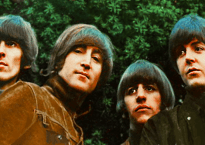
With this month’s release of The Beatles U.S. albums by Capitol Records and my ongoing re-appreciation of the group’s library of songs, I’ve decided to reprise a series…

Hoping lightning would strike twice, emulating A Hard Day’s Night, Help! (released on 6th August, 1965) contained the songs from the ’65 film on side one of the album, with the other side devoted to other new material. Moreover, prodded by others’ success, The Beatles began to push at fans’ and critics’ expectations.

The group’s more somber Beatles For Sale album, coming off their hectic touring/filming/appearance schedule, set a more cynical tone for its 4 December 1964 release. Still, it represented a maturing work, and another highly successful LP in the UK (eleven weeks at #1).

“The fresh sounds revealed on Life in the Tropics are sure to please you because of their melodic elements, rhythms, brass, and great guitar of Russ Freeman.”
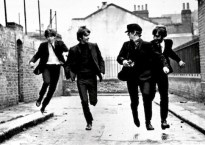
The Beatles A Hard Day’s Night album was the third album in eighteen months to be released by 10 July 1964. Timed to coincide with the release of their first movie. One that completed the catapult to worldwide superstardom. The album reached #1 in the UK charts and was cemented there for 21 of the 38 weeks spent in the Top Twenty. The U.S. soundtrack LP spent 14 weeks at the top of our album register.

The With The Beatles album was going to make an impression no matter what. The important sophomore release for the newly in-demand group would gather attention from fans and critics eager to catch more of the British Invasion. Witnessing the expansion of Pop music, in the bargain. That it was released on November 22, 1963, the day John F. Kennedy was assassinated in Dallas, Texas, would be its counterpoint.

 It Rains... You Get Wet