
One for the Dance Floor: Tired of Being Alone by Al Green
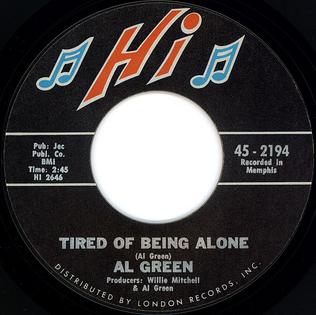
Song Title: Tired of Being Alone
Sung by: Al Green
Released: June 14, 1971
Recorded: 1971
Genre: Soul
Length: 2:43
Label: Hi (45-2194)
Writer(s): Al Green
Producer: Willie Mitchell
 It’s somewhat startling to note I began this series almost a dozen years ago. A lark initially on how popular songs and those “… school-sanctioned social events, especially for those in junior and senior high school, … the dances they threw” had an effect on moi. Yes, as a typical male teen, I needed something like this to cross thresholds in my social development. What I noted as getting passed the notorious “ness” brothers — awkwardness and self-consciousness.
Seems it became more than just finding the nerve to ask another to join you out in the middle of the gym floor to shake a leg, as it were.
Should be said, that dancing with the opposite sex could, and did, have complexities. And at least for me, an effect going forward. The music of the time bridged gaps, at least temporarily, for the hormone-fueled lot of us. Of course, there could be ramifications with who you asked to dance, and what happened when they accepted, in the early 1970s. As mentioned in a previous post, “The push to achieve the reform goals created in the ’60s was escalating, along with the retaliation.”
Like a great many places in the country, some concepts still cut along racial lines1.
Captured well by Bruce Hornsby & The Range in 1986 with The Way It Is
A young Latino male like myself by then certainly knew the state of things, especially living in a predominately white suburb since the 5th grade. My Hispanic2 family wasn’t the only one making inroads in this neck of blue-collar suburbia at that time, though we were few and far between. Most of my school friends, including the only one3 I still know to this day, didn’t look like the majority and were supposed to know our place4…
“No surprise, minorities clustered amongst themselves3 during breaks/lunch and afterschool for a kind of herd protection, which left little for the good sort of interaction.”
One would think I’d feel part of whatever group I was caste in and be happy with it. But given my grandmother’s need for her offspring to be assimilated into the American Dream, that often created its own dichotomy even among my fellow Mexican-Americans, as noted here. Ironically, when we lived in the nearby unincorporated community of Florence, it was much more ethnically diverse. But truth be told, our Anglo neighbors steadily moved away as it diversified.
For this reason, while I identified as Chicano7, still felt somewhat separate from them. Isolated as well among the people I lived next door to — all in all this nagged at me as a teen. By my 17th year, while a senior in high school, part of which occurred in 1971, I decided things needed to change for me. To the regret of the grandmother I lived with, I must admit.
I’ll pause here to let that sink in and highlight Allmusic’s Stephen Thomas Erlewine’s bio of the singer-songwriter who produced the ballad noted in this music post, which was one of Al Green‘s best:
“The preeminent R&B singer of the 1970s, Al Green specialized in smooth soul that found common ground between the carnal and the spiritual. Green’s sensual falsetto found its match in the tight, immaculate Memphis funk shepherded by Willie Mitchell, the head of Hi Records who signed the Grand Rapids, Michigan singer after “Back Up Train” broke out of its regional hit status in 1967. With Mitchell behind the boards, Green released a series of albums that showcased how he developed into an exceptional interpreter of modern standards…”
The tune Tired of Being Alone along the lines of the sweet soul songs of the Sixties, catapulting Al Green5 onto the ’70s music scene. Back then, friends and acquaintances coyly referred to this tune as “begging” music but made sure they’d not miss an opportunity to slow dance to it as we broke for Summer. This ballad would begin a string of classics that included “Let’s Stay Together,” “I’m Still in Love with You,” “Call Me (Come Back Home),” and “Here I Am (Come and Take Me)”.
Charting in the Top 10 for both Pop and R&B that year, it stayed on many a record playlist at school dances, wedding receptions, quinceañeras, and house parties through to the New Year. Green’s forlorn and soulful lead vocal gathered so many on the dance floor to share in its emotion. As mentioned, communities of color already shared an appreciation for Rhythm and Blues music. Especially the much-loved older slow dance variety played in the Chicano get togethers I’d visit.
So, feeling neither fish nor fowl among those I hung out with, chafing at contemporary racial expectations of who I was expected to date and later marry, decided to embrace being different in my last year of high school6. Began that by ditching expectations. The reason why I asked an attractive African-American girl I’d met earlier in the school year to a movie date before 1971’s Thanksgiving. No doubt about it, the “ness” brothers long kicked to the curb by now.
We continued to see each other outside of school into 1972, but realized this hid the interrelation and we had nothing to be ashamed of. So, at one of the last school shindigs I attended, asked this girl whom I liked the more I came to know her and her family, to dance to this Al Green song when it came up from the gym’s speakers. Yes, was nervous if she’d accept my extended hand now out in the open but the dance floor overcame a lot. And she did.
After that, our relationship certainly got noticed by others at school7, unsurprisingly, and she and I felt the changes in how other students viewed us8.
With some notoriety, we’d date for the rest of the semester, as I’ve covered on the blog. Upon my graduation, I’d take her to Grad Nite9, and after catching up with our sleep the next day, take her to see The Godfather. Stayed together, though we continued to get stares and whispers from those who saw us10, through the summer before I started junior college that Fall. Always felt welcomed by her mother, but mi abuelita expressed her dismay with the situation for years11.
This then the sea change that manifested care of those school-sanctioned socials on the dance floor; influencing who I’d date and want to be with going forward via that one weighty step12. And why this one song still registers with me, which I’d also recall years later with others13. I’ve no doubt whatsoever that these communal experiences, from junior high’s on through to that final Spring on my senior high’s gym floor, brought me to this point and time.
Married to the love of my life, with two beautiful and smart children as a result, and happily celebrating our 35th wedding anniversary on this day.
The entire series can be found here.
I'm so tired of being alone
I'm so tired of on-my-own
Won't you help me girl
Just as soon as you can

People say that I've found a way
To make you say that you love me
Hey baby, you didn't go for that
It's a natural fact
That I wanna come back
Show me where it's at, baby

I'm so tired of being alone
I'm so tired of on-my-own
Won't you help me girl
Soon as you can

I guess you know that I, uh, I love you so
Even though you don't want me no more
Hey, hey, hey, hey, I'm cryin' tears
All through the years
I'll tell ya like it is
Honey, please love me if you will

Yeah baby
Tired of being alone here by myself, now
I tell ya, I'm tired baby
I'm tired of being all wrapped up late at night
In my dreams, nobody but you, baby

Sometimes I wonder
If you love me like you say you do
You see baby, I, I, I been thinkin' about it, yeah
I been, I been wantin' to get next to you baby
You see, sometimes I fold my arms, I say, mmh-hmm-mmh
Oh yeah
Oh baby
Meeting you has proven to me
To be my greatest dream, yeah

I'm so tired of being alone (Tired, baby)
So tired of being alone (Yeah, you don't know what I'm talkin' about)
So tired of being alone
Sometimes late at night I get to wonderin' about you baby
I'm so tired of being alone (Oh baby, baby)
So tired of being alone
So tired of being alone

I'm so tired of being alone (Oh baby)
So tired of being alone (You're my heart's desire)
So tired of being alone
- Interracial marriage wasn’t legalized till 1967 by the United States Supreme Court when it ruled unanimously in Loving v. Virginia that anti-miscegenation laws are unconstitutional. After Loving, the remaining state anti-miscegenation laws were repealed; the last state to repeal its laws against interracial marriage was Alabama in 2000. ↩
- The term Hispanic was adopted by the United States government in the early 1970s during the administration of Richard Nixon[15] after the Hispanic members of an interdepartmental Ad Hoc Committee to develop racial and ethnic definitions recommended that a universal term encompassing all Hispanic subgroups—including Central and South Americans—be adopted.[16] ~ Wikipedia ↩
- He is a Japanese-American of mixed heritage (Japanese mother and white American father). ↩
- “During the 1940s and 1950s, South Gate was one of the most fiercely segregationist cities in Southern California. Gangs of white youths were known to prowl the streets looking for blacks who dared to cross over from neighboring Watts. One of the most infamous clubs of the area at that time was the “Spook Hunters“.” Latinos later “…became dominant in the 1990s as working-class Hispanics and immigrant Latin American families filled the vacuum left by non-Hispanic whites leaving for more space in the outer suburbs.” ~ Wikipedia ↩
- The singer-songwriter knew a thing or two about heartache and it came across clearly in his lyrics and song delivery. Though Green never named the object of his affection in “Tired of Being Alone,” he made national headlines in October 1974 when his ex-girlfriend, Mary Woodson, “dumped a pan of scalding grits” on the singer as he was getting out of the bathtub and then promptly committed suicide in the adjoining room by shooting herself. ~ American Songwriter ↩
- Another of the reasons I’ve always referred to high school as a cauldron, is mainly for the things that it boiled up and brewed over time. ↩
- Unexpectedly, once our “going steady” became known, a pair of other couples who were quietly dating interracially made themselves known to us; another “minority” that clustered among themselves back then. ↩
- Some of my Chicano acquaintances pretty much gave me the silent treatment from that moment on — and a few of my black classmates would ask what I was doing, but they never stopped talking to my girlfriend and me. ↩
- Grad Nite was the practice of having an all-night party (around 10 PM to 5 AM) with your fellow high school graduates. In southern California, this was held at Disneyland in Anaheim. ↩
- Those who dated interracially in the ’70s and ’80s will recognize this, and some experienced worse; the 1990s seemed more accepting of mixed couples, and it’s pretty commonplace nowadays. But back then, some would express a palpable hostility toward those who challenged the status quo. ↩
- My mother never gave me any flak about who I dated, and her mother stopped giving me grief on that subject after her daughter died at the too-young age of 53. ↩
- I’d still also date Latinas, and never forgot my heritage or family, but that wouldn’t be who I’d eventually marry and have children with. ↩
- My first college girlfriend was also into Al Green, as well decades later my future father-in-law (for even longer); doubtless, I eventually grew on the latter while dating his daughter after I told him how fond of the artist’s music many of us were while seniors in high school. ↩
 It Rains... You Get Wet
4 Responses to “One for the Dance Floor: Tired of Being Alone by Al Green”
Terrific post for a legendary singer…I am buying up classic vinyl and never get the “greates this” – I like to buy the original and see the other songs on the album as well as the hits…and Al has a voice that could make the phone book catchy! Great story!
LikeLiked by 1 person
Thanks so much, John. And if you want to get the original album that has Tired of Being Alone, it’s this one:
https://www.discogs.com/release/1431301-Al-Green-Al-Green-Gets-Next-To-You
It’s a great one for the collection, my friend. 🙂
LikeLiked by 1 person
Thanks for that!
LikeLike
[…] am today. And while I treasure that it better framed my identity, by my senior year of high school I’d move on in a different direction, musically. And while I was at it, take what I learned here and expand it further, culturally. To […]
LikeLike