
Best Album Covers: Black Sabbath
This is the next entry in Best Album Covers, a series begun right here. The first successful long-playing microgroove record for the phonograph was introduced by Columbia Records back in June of 1948. Yet, album covers (the paper board packaging that held them) didn’t come into their own graphically till decades later. Eventually becoming the cultural stamp on the music of the time. Catching the eyes of potential record-buyers and later their ears and minds. Melding the musical experience with the artist into a unique visual form.
Why Compact Disc versions of album art don’t exactly raise the same reaction these days is looked at in this post. Although music label artistry continues to be noticed and discussed among the material published today. The bits and bytes are looking over their shoulder, though, because vinyl hasn’t entirely gone the way of the dinosaur. Online or at the record shops still out there. Cover art hasn’t lost purpose, either for old and new. Mostly, it’s my contention while digital reigns supreme, its vigor among fans lacks the tactile passion of the past LPs.
Hence the reason for this series. Some register more with me musically than others, though. Yet, the artwork will always take center stage, at least here. Let’s continue, shall we?

Since it is Halloween season, I thought to bring back this series; but to do that required an album cover with a distinctly spooky aura. To put it another way, one matching the horror films, pictorially, that accompanied the decade it was in. Along with marking its musical genre uniquely, as this one did the instant the record debuted1. Hell, the album I’ll highlight, even its title matched the band’s name, which said it all2. As noted by James Christopher Monger’s AllMusic review of their first LP:
“A metal institution whose influence cannot be overstated, Black Sabbath pioneered the genre as they constructed the framework for subsequent subgenres within metal, with entire movements rising from blueprints laid out in single Sabbath songs. From the end of the 1960s and throughout the entirety of the ’70s, the band became legendary for the doomy chemistry between its players: Ozzy Osbourne‘s primal vocals, Tony Iommi‘s seismic riffing, Bill Ward‘s bluntly powerful drumming, and Geezer Butler‘s thunderous basslines all congealed into a sinister breed of hard rock and occult-fixated songcraft the world had never heard before.”
I can’t say Metal (short for Heavy Metal) stuck as a genre for me. Oh, I’d spend a certain amount of time as others my age, and had high school acquaintances back then who did similarly. So if I was over their digs, this was the album they were raving about, or cranking up the volume on their parents’ stereo — with them not there, of course — to emphasize the point. I got into Led Zeppelin by the end of the ’60s, so I gave this a whirl3 with those who were into distorted guitars and vigorous vocals.
Yet, it was the dark, unsettling imagery in the cover art that came with the band’s arrival that drew my attention — admittedly, it creeped me out, which was undoubtedly its primary purpose.
“The haunting photograph was conceived and shot by Keith Macmillan, a British photographer also known as Keef. He worked closely with the band’s label Vertigo Records to create a visual that matched the dark, eerie tone of the music—something totally different from the psychedelic or colorful artwork popular at the time.” ~ Slightly Fuzzed
The lone clothed figure4 standing in front of a water mill5 is haunting, whether it’s your first time seeing it or not. And ominously, it marked the distinct sub-aspect in the genre that openly flirted with occult and demonic themes. Reflected perfectly in the foreboding music Black Sabbath brought to the forefront. Indeed, it distinguished Western teen rebellion, whether in the ’70s or another decade, and set visually and musically against a stark scene that had nightmare written all over it.
Yet, in being so eerie, I’ve no doubt more than a few dressed like the pictured apparition for Halloween thereafter.
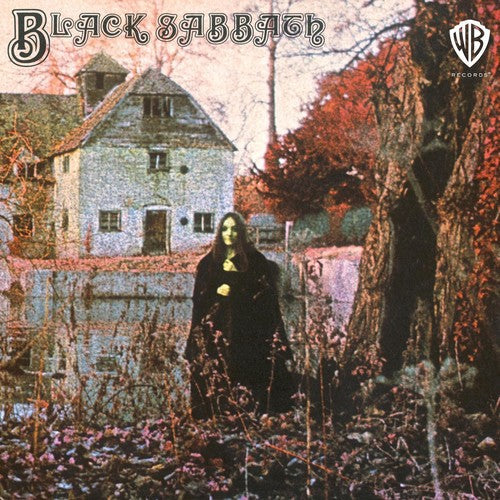
Artist: Black Sabbath
Title: Black Sabbath
Date: 1970
Label: Warner Bros
Side one
- “Black Sabbath”
- “The Wizard”
- “Behind the Wall of Sleep”
- “N.I.B.”
Side two
- “Evil Woman”
- “Sleeping Village”
- “Warning”
- “Wicked World” (1996 CD Reissue Bonus Track)
The entire series can be found here.
- Which happened to be on Friday the 13th, February 1970, the 44th day in that year. ↩
- A “black sabbath” literally refers to a midnight meeting of witches and demons, or a dark, satanic inversion of the traditional holy day of rest. It’s also the name of a 1963 horror anthology film directed by Mario Bava. ↩
- “Black Sabbath received generally negative reviews from critics upon its release but was a commercial success, reaching number eight on the UK Albums Charts and number 23 on the US Billboard Top LPs chart.[7]” ~ Wikipedia ↩
- Louisa Livingstone was the model pictured, who later described the experience as “freezing cold” during the shoot. ↩
- The cover photograph was shot at Mapledurham Watermill, situated on the River Thames in Oxfordshire, England. ↩


Are you talkin’ to me?