
Ran (1985)

Ran (乱, translation: “chaos” or “turmoil”)
In the past few years, besides having less time than usual, let alone a pandemic to deal with even if many now say is over, found myself rather stumped at selecting a film for my Memorial Day viewing and celebration. As opposed to last year I’ll not miss my annual habit of watching war films in remembrance of the men and women who died serving this country. In the past, World War II-based movies have dominated my picks, but once more I’ve strived to do something different.
On that account, felt a definite need to look to another place and time away from the titanic struggle of the 20th century. Pointed toward another era and aspect that involved no less tumult for those involved. Perhaps, this was just an excuse to examine a masterful work by a notable filmmaker I keep coming back to. A film that has grown in reputation with each re-visit and that has held my study since its release almost three decades ago.
Many war films base themselves on those directly on the battle lines, above or below the water line, or in their own backyard. What I hadn’t appraised in this series were those who instigate the warring calamity their underlings have to fight or let alone survive. But what movie to use for this instance? Both Paths of Glory and A Bridge Too Far initially came to mind with their portrayal of hubris by military leadership that costs and wastes the lives of others, needlessly.
But I believe there’s one that rises above those, cinematically and even more personally, which befits the stated criteria: Akira Kurosawa’s masterpiece, Ran.
“You have not experienced Shakespeare until you have read him in the original Klingon.” ~ Star Trek VI: The Undiscovered Country
This adaptation of The Bard, like the director’s reworking of Macbeth from 1957 — Throne of Blood — is a tale of a warlord’s pomposity and actions that jeopardizes all. Here, that of his sons and clan after he abdicates his throne. Yet, this story’s conversion to another’s culture loses nothing, and only gains in its beautifully catastrophic recital. Contrary to what Star Trek’s Chancellor Gorkon may think, I firmly believe you’ve not read Shakespeare till you have visualized it in Japan.
And since initially seeing it back in ’85, I have kept coming back to it — finally seeing this period saga for the supreme war film that it is.
Brief synopsis: In a time of relative tranquility, the Japanese warlord Hidetori Ichimonji has come to a grand decision. It’s time to retire and enjoy the fruits of his years-long conquests. But rather than pass the torch to one, he will divide his fiefdom among his three sons. The elder two — Taro and Jiro — agree with their father’s decision and promise to support him for his remaining days.
However, his youngest, Saburo, disagrees with all of them, arguing that there is little likelihood the three siblings will remain united. Insulted by his son’s audacity, the warlord banishes the outspoken Saburo. But as Hidetori begins his retirement, he soon realizes that his two eldest sons are selfish and therefore will not be keeping their promises. This leads to war and only the banished Saburo can possibly save him.

Hidetora: “I am lost…”
Kyoami: “Such is the human condition.”
Review: The AFI1 defines “epic” as a genre of large-scale films set in a cinematic interpretation of the past. Am sure I’m repeating what others have already stated, but Kurosawa’s final film of feudal Japan is simply a master class on that category of filmmaking. Ran is truly an incredible piece of cinema that should be listed among those greats. Every frame, from the opening shots of the horsemen against the dramatic landscape to the final lonely scene along a far-flung cliff, heralds that achievement.
Whether the famed director originally intended to remake what is likely Shakespeare’s finest, in his country’s warring period2 matters not. The reinterpretation was not without its challenges, though, as King Lear is one only the most experienced dare attempt. Almost three decades had past since the director’s loose adaptation of Macbeth made its way into movie theaters with Throne of Blood3. Ten years in the making, Ran would intersect with the remarkable end to Kurosawa’s stellar career.
One marked as his most bold in filmmaking, and a work that wouldn’t have happened without benefit of the foreign financing he received to get it all done before his passing4.

As with Shakespeare’s Lear, the film is about an aging lord, this time being of the prominent and prosperous Ichimonji clan. Looking to retire and pass the power he has built on to Taro, the eldest of his three sons. That’s it has been amassed through war and the slaughter of his enemies and innocents means there’s a reckoning to be had. But as we’d expect from Shakespeare, there will be plenty of irony, death, and of course, an unhappy ending. In terms I’d imagine the writer Mark Twain made clear:
“It cannot compromise for less than a hundred cents on the dollar, and its debts never outlaw.”
And with the banishment of Saburo, the youngest of Hidetora’s children who dared speak the truth about his father’s foolishness, the Japanese filmmaker begins to unravel all the feudal lord has held dear, and on cinematically spectacular and tragic levels. Soon, the former lord is chased away from each of his sons’ castles and becomes mad when he understands that one of them is trying to kill him.

The three brothers, in the tradition inherited from their father, end up fighting for control of a rather large and blood-soaked Kingdom, as their own lust for power ever grows. Add some old rivalries and soon-to-be former allies into the mix, and the four armies that end up facing each other on the prairie will come as no surprise. Lord Ichimonji’s formerly peaceful dominion, one built upon the skeletons of other contenders, is overwhelmingly reduced to a distant memory and fitful disillusion at best.
Akira Kurosawa redefined what an epic film is in Ran with astonishing craft, entirely believable characters, and awe-inspiring battle scenes with nary the use of any special effects or CGI. He simply breathed new life into the best tragedy of Shakespeare in his own inimitable way. Using some of Japan’s own history and regional conflicts that takes a backseat to no one on the bloodshed scale, no matter what Game of Thrones would have you believe.
Everyone who played a part in the production of this film deserves some kind of recognition. The acting went beyond the expected and the associated characters were certainly conceivable. Some viewers lamented that their later falling out5 prevented the great Toshiro Mifune from heading this Kurosawa cast; but that only short-changed a brilliant performance by another stellar actor who many think his equal (count me as one), Tatsuya Nakadai6. This is the topper to a legendary career.
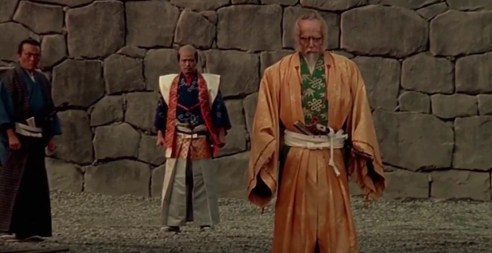
I’ve no doubt Tatsuya’s interpretation of Lear was on par with his work in Tsugumo Hanshirō’s masterpiece, Harakiri (1962), as it’s that great. He starts off weary and only builds on it with his descent into madness. It’s both moving and heartbreaking, even when we learn of Hidetora’s dark past as Ran progresses. But, if you know how well Tatsuya handles unhinged (see the ’66 The Sword of Doom to see why I say that), this was tailormade casting for the notable Japanese actor. He’s perfect for the role.
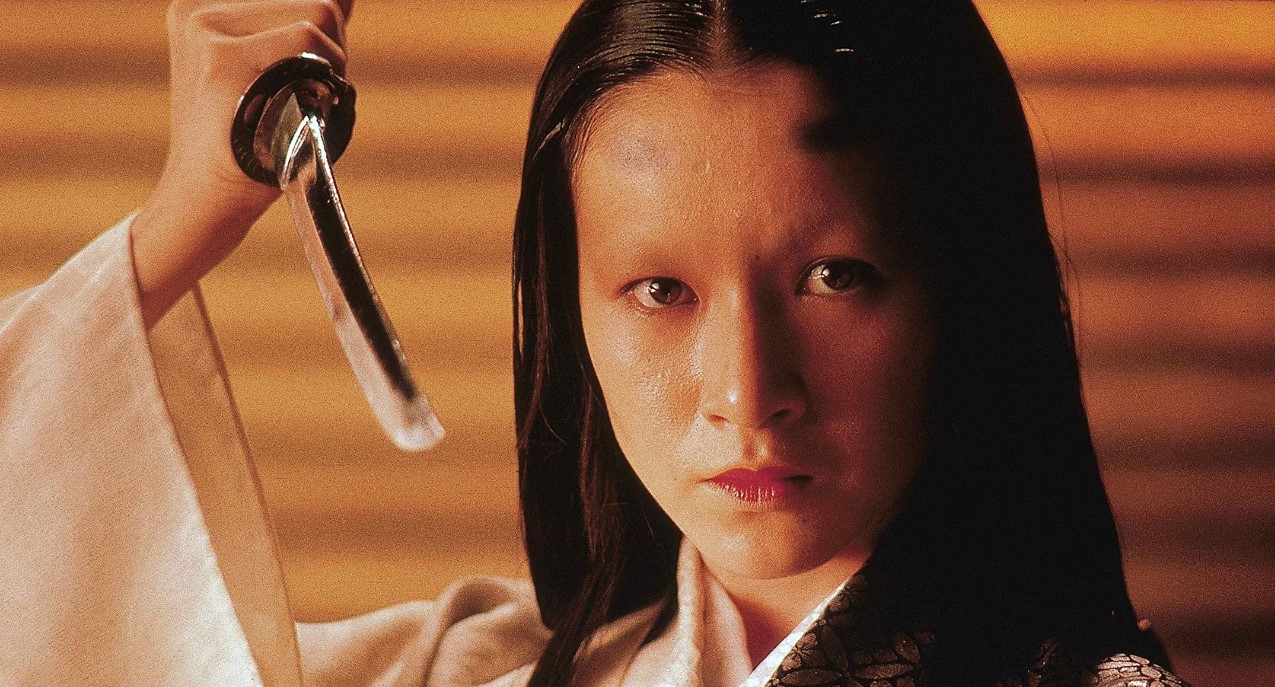
Add in a number of other stellar performances, like Akira Terao, Jinpachi Nezu, and Daisuke Ryû as the sons in question, and most notably, Mieko Harada as the Lady Kaede involved with two of them. And she was not going to let something like political marriage with Hidetora’s clan get in the way of settling long past scores against her family by her father-in-law. And the result was a cast and compunction as ambitious as the film. Just one not very well known to many in the West.
Kyoami: “Are there no gods… no Buddha? If you exist, hear me. You are mischievous and cruel! Are you so bored up there you must crush us like ants? Is it such fun to see men weep?”
Tango: “Enough! Do not blaspheme! It is the gods who weep. They see us killing each other over and over since time began. They can’t save us from ourselves.”
All of this is codified by the director’s appreciable script, joined by Hideo Oguni‘s and Masato Ide‘s writing. Making use of King Lear’s expositions and contrasts so that the film is as poetic in the observations of its pitiful subjects as its katanas are sharp. By the same token, this does make for one very bleak journey as we suffer right along with Hidetora and his clan. Although, it is equally and beautifully resplendent in the visualization7 of those lives as they are plucked so gloriously.
I’m well aware that Akira Kurosawa’s Seven Samurai has long been considered his greatest film, but the more I see Ran with its stunning imagery and poignant drama, even if based on another work, I’d now argue that. The film’s superb battle scenes, swathed in color and devastation, are suitably horrific but mesmerizing. Its faint humor only heightened the tragedy on display. The director’s last Jidaigeki, like Shakespeare’s’ words and Kurosawa’s artistry, made the journey so worth it.
The 1985 epic homologous of King Lear plainly enough with the father’s own greed, jealousy, and lust for power manifested in his children, but its transposition to feudal Japan also made it something else altogether. Kurosawa’s storytelling skill in this time and period, along with his visual artistry on the big screen, made it that much more haunting. With that, he built upon another’s masterwork and somehow expanded it. And in doing so, made it more sweeping, compelling, and his.
- The American Film Institute. ↩
- “Akira Kurosawa began writing the film 10 years before its release and said that it wasn’t originally meant to be based on Shakespeare’s “King Lear” but came to that during the writing process.” The story was inspired by samurai legends, but essentially a retelling of William Shakespeare‘s greatest play. ~ IMDB ↩
- Kurosawa’s longtime acting muse, and likely Japan’s greatest star, Toshiro Mifune, portrayed the grizzled war general Washizu who goes to treacherous lengths to fulfill his wife’s longing for him to become ruler that bring Shakespeare’s themes of tragic betrayal, craven ambition, and inevitable vengeance into inevitable fruition. ↩
- When his Japanese film studio would only sign on for film distribution, Kurosawa found a welcome helping hand in the French producer Serge Silberman, a man willing to gamble and fund Kurosawa’s next project. ↩
- “After 16 films together, the last being 1965’s Red Beard, the two film legends parted ways. A rift between the two, who had once been in deep admiration of one another, had developed. There are several reasons why Kurosawa and Mifune fell out of favour with one another. One explanation is that Mifune had sought to begin his own production company, but Kurosawa had suggested against it because he privately felt that he would not be able to cast him as easily.” ~ Far Out ↩
- Tatsuya_Nakadai portrayed Mifune’s rival Unosuke in 1961’s Yojimbo, and even had an uncredited role in Seven Samurai (1954), both directed by Kurosawa. ↩
- By the time he had made 𝑹𝒂𝒏, Kurosawa had lost nearly all of his eyesight. For approximately seven years before filming began, the director had painted storyboards for every shot in the film. ↩
 It Rains... You Get Wet
4 Responses to “Ran (1985)”
Stunning epic, one of Kurosawa’s best. By the way, I didn’t know he was nearly blind when he shot the movie. That’s shocking because this is one of Kurosawa’s best-looking productions.
LikeLiked by 1 person
It is, indeed, Eric. Yeah, the fact that Kurosawa’s failing eyesight didn’t deter him in this stunningly beautiful production is a testament to the man’s skill and artistry. Many thanks for the comment. 🙂
LikeLiked by 1 person
Count me as one who is not familiar with this film. Wonderful write-up! I’m going to try to find it to watch.
LikeLiked by 1 person
Yes, it is one of Kurosawa’s best. Spectacular while being quietly devastating in its storytelling. Many thanks, Rachel. 🙂
LikeLike