
“Ghosts are real. This much I know.” – Crimson Peak at 10
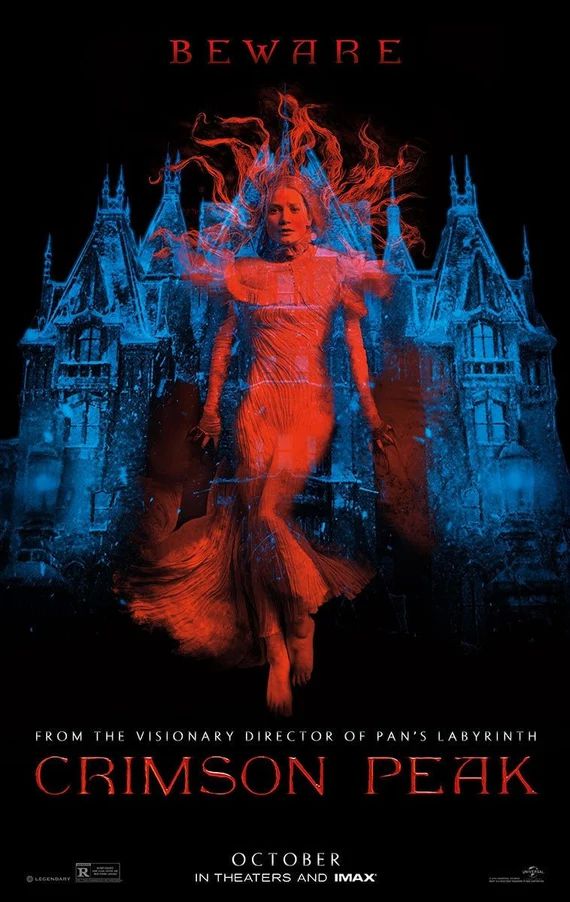
As it’s been nine months since my last post — go ahead and make the pregnant pause comment for those of you who must — it took the tenth anniversary of one of my favorite director’s films to bring me out of my blogging doldrums. That director being Guillermo Del Toro, and the work, one of his most underrated, is Crimson Peak. A film that was underappreciated back in 2015 and didn’t draw audiences or critics as much as it should have, but left quite the impression on the few of us who did.
Thinking back, that pre-presidential election year seems like another age entirely, while the current eon evokes the environment of the Mexican filmmaker’s The Devil’s Backbone and Pan’s Labyrinth1; go figure.
Be that as it may, to finish the film’s initial narration by the story’s winsome protagonist, set forth in the post’s title to fix the mood for this All Hallows Eve post and the tides’ belief in ghosts… “The first time I saw one, I was 10 years old. It was my mother’s. Black cholera had taken her. So, Father ordered a closed casket, asked me not to look. There were to be no parting kisses. No good-byes. No last words. That is, until the night she came back.”
“My child. When the time comes, beware of Crimson Peak.”
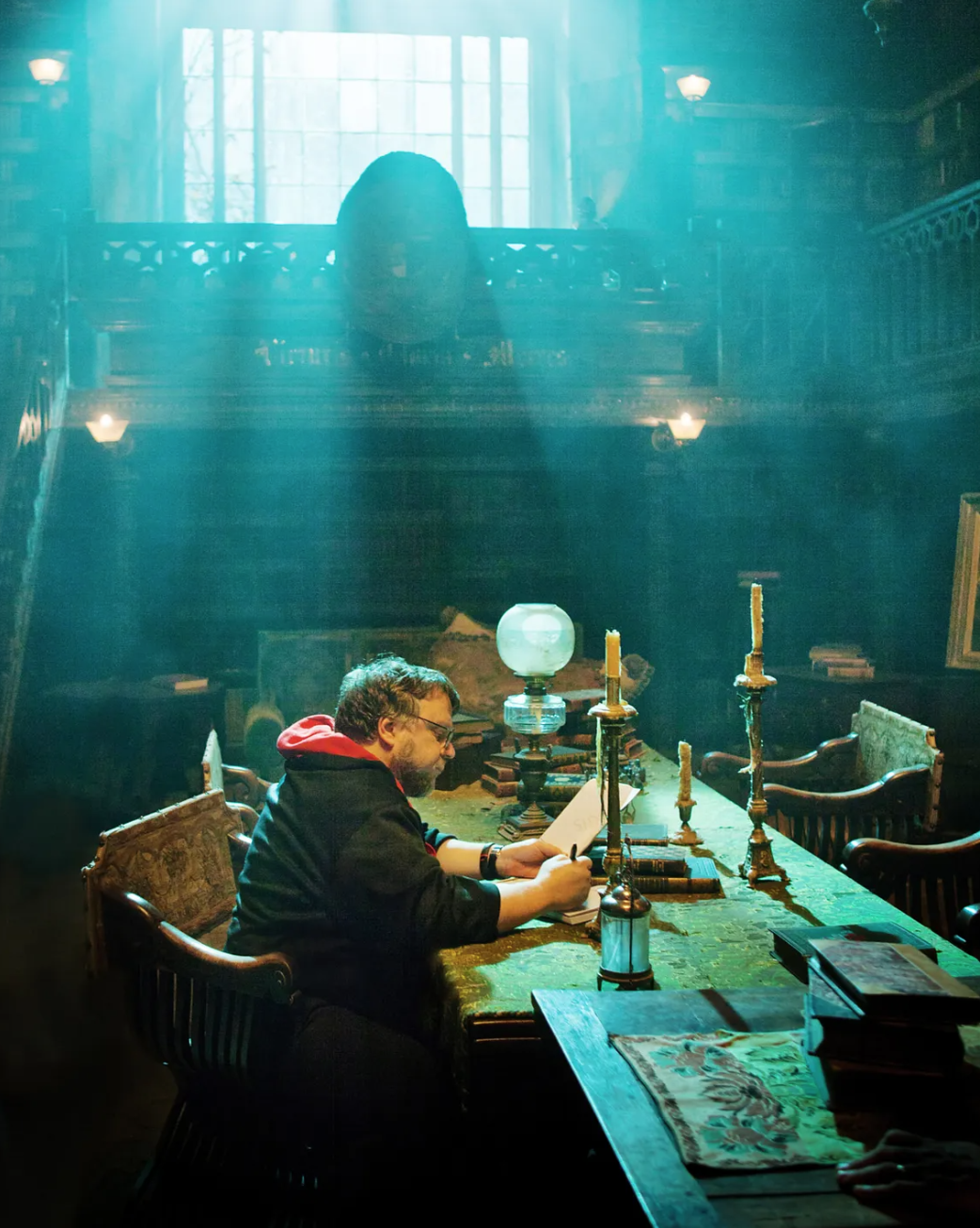 Universal Pictures executives promoted Del Toro’s film to the masses as a straight-up haunted house horror flick. Handcuffing his unique hybrid of a film, one that melds gothic mystery, passion, and the supernatural into something that would doom its reception. The period setting and tonality seem to be what threw them off. You only had to check out its misleading trailers to realize that. Though I for one love its movie posters that meld romance novel art, in the vein of The Silence of the Lambs.
What the studio and audiences couldn’t unknot, at least the opening sequence clued, courtesy of the distinct rouge of the studio emblems that splash at its start, the audience to the film’s heart and what courses through it, forewarning them.
A brief synopsis of the film: In 1887 Buffalo, New York, American heiress Edith Cushing, daughter of wealthy businessman Carter Cushing, is visited by her mother’s ghost soon after her death, warning, “Beware of Crimson Peak.” Fourteen years later, now a budding author2, Edith meets English baronet Sir Thomas Sharpe and his sister, Lucille, who’ve come seeking investment in Thomas’s invention. A digging machine to revive his family’s clay mines, but her father rejects their proposal.
While Thomas and Edith become romantically attached, Mr. Cushing is brutally murdered, raising the suspicions of Edith’s childhood friend, Dr. Alan McMichael. Thereafter, Edith is swept away to a remote gothic mansion after marrying the charming suitor. Pitting her against Lady Lucille, the aggressive protector of her family’s dark secrets. Leaving Edith, who is capable of communicating with the dead, the only one who can untangle the ghostly mystery that haunts the walls of her new home.

While there are a fair number of us absolutely giddy with the promise of Guillermo Del Toro’s upcoming Frankenstein film this holiday season, I find myself continually drawn back to Crimson Peak. And the whys are multifold due to its splendid cast, keen bearing in both acting and art direction, and a uniquely blended story. A tribute to the classic horror films of the ’60s, ’70s, and ’80s 3. Perhaps, with some fealty to a couple of Roger Corman’s Edgar Allan Poe tales thrown in.
 Lovers are the primary narrative of romance, and not surprisingly, with some horror tales. Especially those involving historical settings, as is here. With Tom Hiddleston as the perfectly refined suitor with dark secrets, contrasted with Mia Wasikowska‘s Edith, representing the young Victorian woman. Though of the Buffalo, New York variety. With a solid Jim Beaver4 and an up-and-coming Charlie Hunnam5 filling in as needed for support, nothing was lacking on the acting front.
Edith Cushing: “You’re monsters. Both of you!”
Lucille Sharpe: “Funny. That’s the last thing Mother said, too.”

Yet it’s the amazing Jessica Chastain, as the sister you can’t take your eyes or hands off, that gives Crimson Peak its chef’s kiss. She’s the temptress to Mia’s virgin of classic literature, who plunges the spectacle into the deepest darkest recesses and manages to ring all of the emotions out of each of the characters. No wonder when Guillermo offered her the script for the Edith part, Jessica wisely chose the baronetess, and we’re all the better that the Oscar award-winning director agreed.
And it’s Lucille, along with the matron spectres of the tale, who bring the best out of Edith, and are the primary proofs that the women govern the film.

No doubt, the story crafted by Guillermo and Matthew Robbins purposely impressed that aspect, along with the supernatural. The two personifying a characteristic cinematic combine6, with the former representing the present, and the latter the spiritual reminders of a past. Each refusing to die, and neither never what they seem. Perhaps a bit old-fashioned, yet the story remains one of innocence lost. Though, like classic Victorian novels, social class and privilege, too, are emphasized.
 The contrast between the old and new world, along with the manners and money therein (or lack of it), is also unfurled. Thomas has a baronet, drawing both wonder and suspicion from the Americans he intersects. Edith initially dismisses him before their meeting, stating that a baronet is “a man that feeds off land that others work for him” and “a parasite with a title.” Her father later mocks Thomas for having soft hands and for not having done a hard day’s work in his life.
Mrs. McMichael: “This parasite is perfectly, charming, and a magnificent dancer. Although that wouldn’t concern you, would it, Edith?
Our very own Jane Austen. Though she died a spinster, no?”
Dr. Alan McMichael: “Mother, please.”
Edith Cushing: “That’s all right. Actually, Mrs. McMichael, I would prefer to be Mary Shelley. She died a widow.”
The Cushing’s are the new money, being much better off than the Sharpes in the tale’s financial impulse. Edith lives well, much more than her soon-to-be life in Allerdale Hall. Now, a lonely, barren, run-down estate in the middle of nowhere, England. A formerly florid finca, now its own phantom; a shadow of its former self. Its inheritors reduced to subterfuge and immoral acts just to keep their heads above water, and a chance to stop their own bleeding. Characterized by the bloody clay, they sit on.
The contradiction of the present and the past is never more in evidence than upon arrival at the whispered demesne.
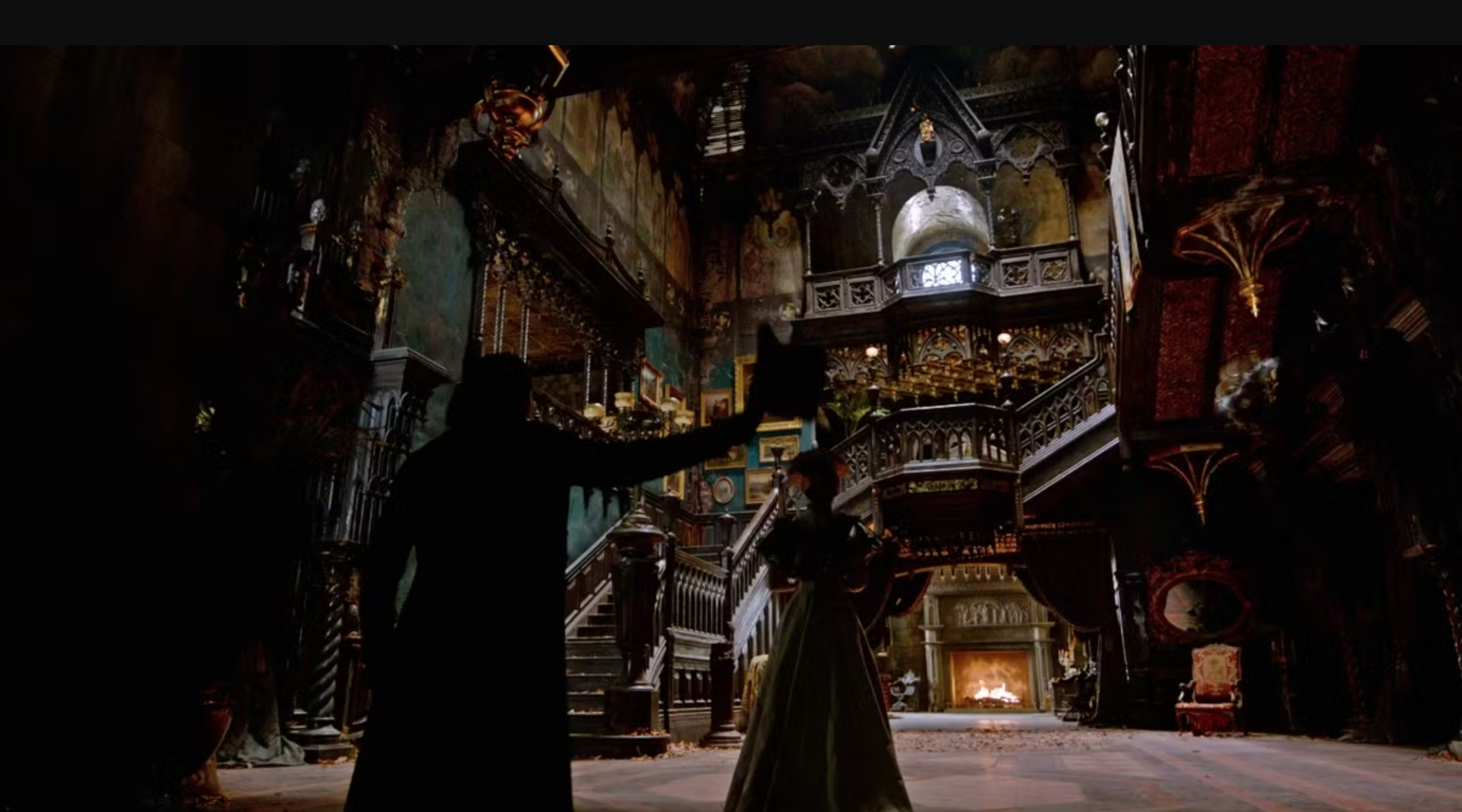
Unquestionably, the other notable character of the film is its central location of Allerdale Hall. Like other notable sets that dominate their celluloid — The Haunting, The Legend of Hell House, and The Shining — the beheld backdrop is a living, breathing, and bleeding persona in its own right. Heightened by Fernando Velázquez‘s haunting score, it is both lush and decayed. An opulent ruin more than capable of holding all of the past sins and tumult within its sculpted walls and staircases.
A manor that is more than just the title of the film — it’s the lodestone that owns the last of the Sharpes.
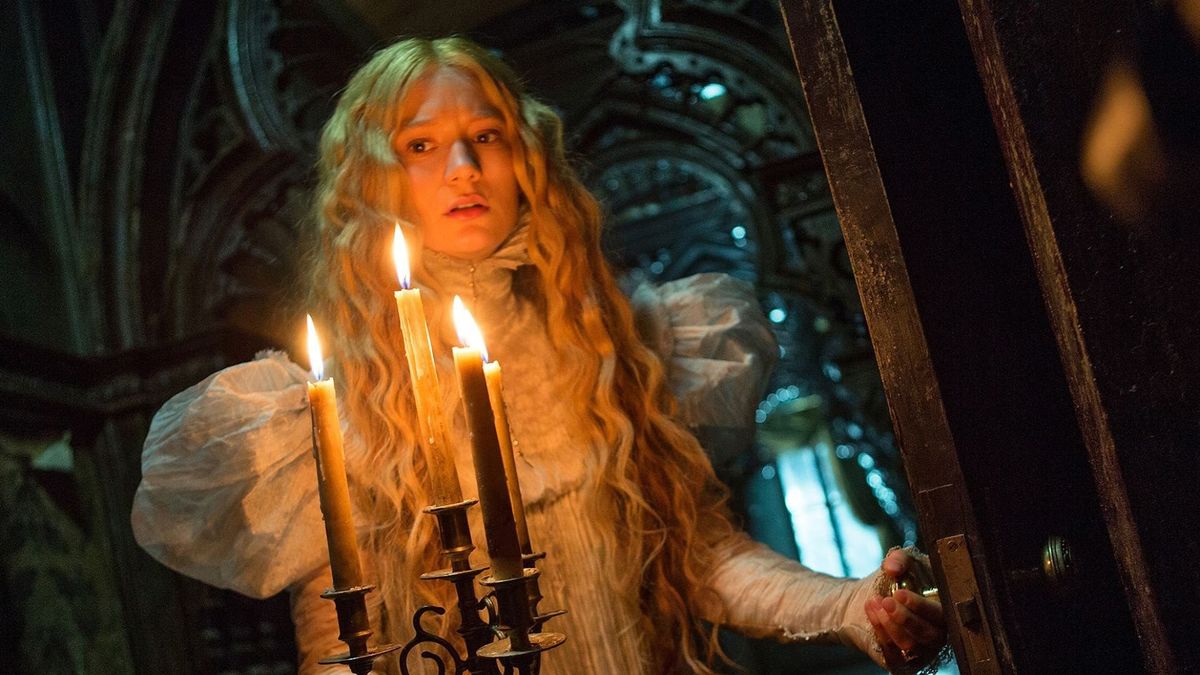 Del Toro, art director Brandt Gordon, and cinematographer Dan Laustsen, used practical builds and digital effects to an extraordinary extent7 in crafting and framing the house called Crimson Peak8 on film. The ghosts within, given physicality by Doug Jones and enhanced with prosthetics and CG visuals, roam the halls and beckon Edith to grasp the awful truth she’s married into, along with the rot of its heirs. No matter its ornateness, this stead is plainly a nightmare to those who reside within.
Edith Cushing: “You lied to me!”
Thomas Sharpe: “I did.”
Edith Cushing: “You poisoned me!”
Thomas Sharpe: “I did.”
Edith Cushing: “You said you loved me!”
Thomas Sharpe: “I do.”
With Crimson Peak, one of Mexico’s masterful moviemakers9 delivered a great gothic romance. One that equally emphasized its high emotions in blood-warm detail and made crystal clear some of the darker elements of passionate love. How it cuts both ways, in almost biblical terms10. Graphically depicting the suffering and corruption the characters endure in atmospheric ways. Even if our heroine somehow finds a way to survive it all, there’s little happiness to be found in it.
The writer-director has built a body of work on the relationship of fairy tales and horror. In rewriting period romance and casting it in a haunted house, Guillermo Del Toro’s film gave an effective treatment to what author Jacqueline Simon Gunn summarized about that deep emotion: “Love makes people do crazy things. And not feeling loved can bring people to the edge of madness.” In no uncertain terms, it epitomized the scars Love can leave behind and that which makes prisoners of all who partake.
Edith foretells what will be pictured early in the film… “It’s more a story with a ghost in it. The ghost is just a metaphor.” By that, the past, but no less than “Love never dies a natural death.”11 The film engraved a passion as haunting as an apparition in the afterlife. No matter if all on screen were a victim of it, there’s a reason we have the term, lovesick12, in our vocabulary. It is why Crimson Peak, along with Pan’s Labyrinth and The Devil’s Backbone, is among the best and most personal films by this director.
And why I, another of Love’s prisoners, am thankful.

Lucille Sharpe: But the horror… The horror was for love. The things we do for love like this are ugly, mad, full of sweat and regret. This love burns you and maims you and twists you inside out. It is a monstrous love and it makes monsters of us all.
- That being the country of Spain during its Fascist period. ↩
- The film’s opening and end title sequences will cleverly show the story was chronicled from a novel titled Crimson Peak, one authored by the surviving Edith. ↩
- Guillermo del Toro‘s inspirations for the film include The Innocents (1961), The Haunting (1963), The Exorcist (1973), The Omen (1976), and The Shining (1980). ~ IMDB ↩
- Carter Cushing, the protective father to Edith, embodied what many of us girl dads know, and what comedian Michael Yo has so adroitly expressed, “…would die for their son and would kill for their daughter”. ↩
- When del Toro pitched the film to Charlie Hunnam he told the actor “that he’d be playing the damsel in distress”, and Hunnam was immediately sold on the movie. ~ IMDB ↩
- See the aforementioned The Innocents, The Haunting, and my pick, The Uninvited (1944), to prove the point. ↩
- Many pieces of furniture in the film were made in two sizes. When a character sits on it or appears on its background, it can show certain emotion. Bigger size – to show the character’s weakness and tenderness, smaller – to show their strength and determination. ~ IMDB ↩
- Though the house was built in its entirety, it had to be torn down at the end of the shoot in order to make space in the studio. ~ IMDB ↩
- Guillermo Del Toro, who won for The Shape of Water (2017), dedicated the film to his Mexican brethren who also became Best Director Oscar winners — Alfonso Cuarón (Gravity, 2013) and Alejandro G. Iñárritu (Birdman, 2014, and The Revenant, 2015). ↩
- In the biblical sense, “passion” primarily refers to suffering and enduring, particularly the sufferings of Christ during his final days, as detailed in the New Testament. However, it also carries other meanings, such as a zealous and enthusiastic desire for God and a strong emotion or agitation of mind, though the latter can be a negative “unbridled passion” if it leads away from God. ↩
- By Anaïs Nin: “Love never dies a natural death. It dies because we don’t know how to replenish its source, it dies of blindness and errors and betrayals. It dies of illness and wounds, it dies of weariness, of witherings, of tarnishings” ↩
- Adjective: in love, or missing the person one loves, so much that one is unable to act normally. ↩
 It Rains... You Get Wet
2 Responses to ““Ghosts are real. This much I know.” – Crimson Peak at 10”
Wonderfully written look at this film. I really hear your passion about the film.
Del Toro is a film maker I struggle with. His movies are always well made, never boring and provide some amazing visuals. But there is also usually one or two elements that keep them from coming together for me. It is never the same element, which tells me I don’t think it is a stylistic conflict between his work and me. I just think there are choices he makes that just end up hitting wrong with me.
I really should revisit “Crimson Peak”. I’ve only seen it once, and while I thought it was solid, it was another case of me wanting to like it more than I did. I want to say the CG overlayed on the ghosts was too jarring for me. But I will also say that I hadn’t seen any Hammer films and only one or two of Corman Poe films back then. These days, I’ve seen quite a few more, so I think I may appreciation may increase.
That said, the score by Velazquez, is one of my favorites to listen to around this time of year. Great gothic romance/horror that just pulls you right in. Great stuff.
Another great blog post. Keep up the great work.
LikeLiked by 1 person
Apologies for the late reply, and thank you very much for your kind words and thoughts. 🙂
LikeLike