
Closing Song and Scene: Steve Jobs (2015)

As I’ve finished another viewing of what’s probably my favorite Danny Boyle film, thought to give this an appreciation via a specific aspect of the film. And perhaps start a series on a facet that contrasts with another, Opening Titles and Song. This then will kick off looking at Closing Song and Scene via Steve Jobs (2015). A film that was a showcase of splendid direction by the British filmmaker, a brilliant screenplay by Aaron Sorkin, and delivered on by a simply marvelous cast of actors.
This film isn’t the first to take a needle-dropped song to help cap off a strong closing scene. Far from it, and I’ve already highlighted some of them in this blog1. Though movies are primarily a visual art form, it’s a recognized standby of filmmakers to use a well-placed song to deepen their picture’s impact by adding other levels of emotion — the audience’s and the music’s — with those on the screen. If matched up perfectly, those moments can and do further the film’s vision and weight.
As done here with the subject of the film; one that couldn’t have been more worthy of comparison and contradiction. On film and in real life, Steve Jobs is one of the pioneers of the personal computer revolution of the 1970s and 1980s, which is still impacting those from that era and beyond. The film explored his ingenuity and perfectionism, and the detrimental effects of both on the man’s family and business life, and those who came into contact with him.
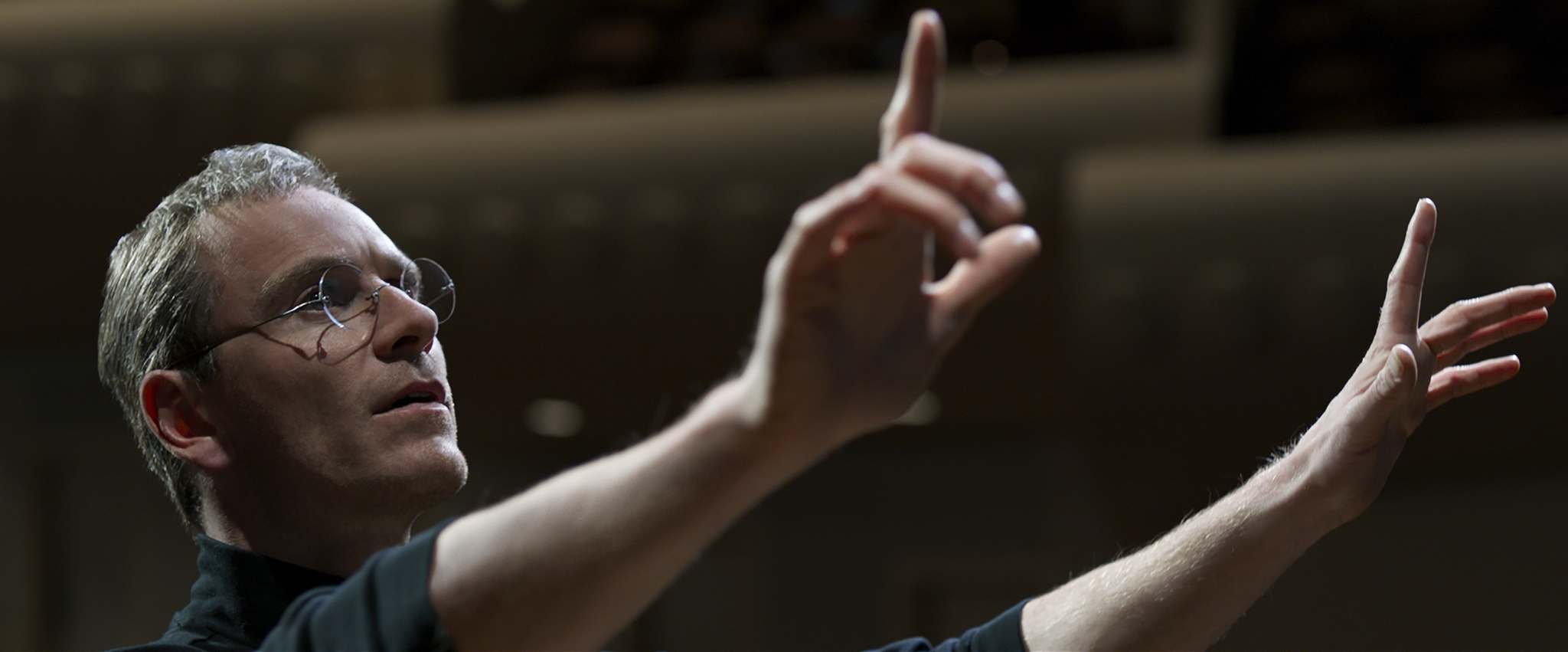
To say the character of Steve Jobs (masterfully portrayed by Michael Fassbender) is both the villain and the hero of the piece would be an understatement. Clearly drawn by Sorkin’s multilayered screenplay, using three key moments of Jobs’ tenure at Apple and NeXT2, it builds to an emotional climax for the tech titan both professionally and personally. The latter involving his illegitimate daughter, the fatherhood of which he denied initially. All while he tried to marry technology with the masses.
Formulating computing and gadgetry for strangers, for their (and his) own profit and legacy, above his own child.
“…and not for nothing but stink is a verb, or make “different” an adverb. You’re asking people to think differently, and you can talk about the Bauhaus movement and brawn, and simplicity sophistication and Izzy Miyake uniforms and Bob Dylan lyrics all you want, but that thing, looks like Judy Jetson’s easy bake oven.”
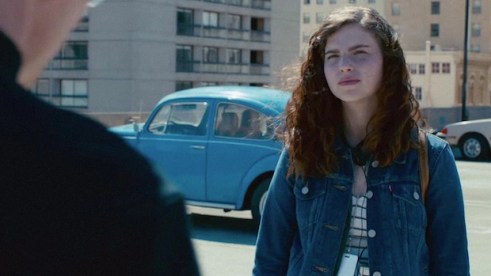
Their final interaction of the film intermixed with Jobs’ triumphant return to Apple, which culminated with the first product that met lofty expectations (compared to the Macintosh3). Here with the tables turned on the victor known for his intellect and bending technology and people to his will4 — which could also be cruelly deployed against those who didn’t meet his demands. That bullying wit, which cowed nearly everyone in the film, is flipped on him by the daughter who learned it only too well5.
Paternity, whether in conceptual knowledge or in human beings, is the driver of the film and this closing scene.
Lisa: “Why you’d say you aren’t my father.”
Jobs: “I’m poorly made.”
I guess it’s the reason this scene stands out with me, being I had one of “those fathers” who didn’t stick around6. Yet here, we get a somewhat unexpected happy ending. Jobs having a knack for landing on his feet when everyone or all else fails, using the idea of putting “…a hundred songs, a thousand songs…” in his daughter’s pocket7 to reconnect with her. Ultimately, bringing his estranged child back into the fold, and backstage to watch her dad for the first time in his element.
Marrying the idea of what Steve Jobs meant to an entire generation who weren’t behind the curtain when the groundwork of personal computing was being laid out via this key relationship of the film. And it’s during that segment, while walking over to Lisa explaining why he wants to meld music to ones and zeros for her sake and that of others when we first hear We Grew Up at Midnight by The Maccabees break the surface in the scene.
The Maccabees’ guitarist Hugo White saw the film in the Big Apple. He told NME: “I wrote the lyrics for that one, so to go from writing lyrics in my bedroom to watching it in a cinema in New York was a special moment.” ~ Songfacts
It seems strange to needle drop a song from 2012, the year after Steve Jobs’ death, by a British Indie band that wasn’t even formed till 2004, but it works extraordinarily well. Chosen by director Danny Boyles, a fan of them, for this segment as it elicits a coming of age — in all its glories and pitfalls. The idea is depicted via its quiet start and end, interrupted by two big vocal and instrument crescendos that speak to the emotional inflection of the daughter and audience alike to a surprising degree.
Further emphasizing the change we all reach with time, seeing ourselves and/or others in a new light, imperfect or not, and expressed so eloquently via music and lyrics.
Along with audience’s by way of this needle drop
It’s that epiphany by his daughter Lisa, who has felt desertion, one shrouded by personality and a lack of piety throughout the film, that gives the scene its closing contradiction and a deeply affecting gravity. Which has been part of the perceived messaging of the filmmakers from start to finish. Showcasing someone we could easily condemn and yet see why so many (perhaps even yourself) could and did cheer Steve Jobs on during “…the most tectonic shift in the status quo…” that accompanied him.
Outside of the window
I was sticking with you
We were only kids then
We’d get soaked right through

We used to tell them
I was staying at yours
Sheltered in our own worlds
We’d watch the rain right through

We grew up at midnight
We were only kids then

Loving woman loving man
Here for you doing the best we can
Hard to figure hard to bare
Hard to think knowing how much you care

It’s the strangest thing through thick and thin
All this time kept the promise you made
If you’re telling I’ll be told
I’ll come running and be there as soon as I can

Outside of the window
I was sticking with you
We were only kids then
I was staying at yours
Sheltered in our own worlds

We’d watch the rain right through
We grew up at midnight
We were only kids then
We grew up at midnight
We were only kids then
But that night we knew
- As noted on this blog post and this one. ↩
- Largely through the fictionalized onscreen launches of the Macintosh in 1984, the NeXT computer in 1988, and the iMac in 1998. ↩
- Which also debuted at the Flint Center for the Performing Arts at De Anza College. ~ Wikipedia ↩
- Reality distortion field (RDF) is a term first used by Bud Tribble at Apple Computer in 1981, to describe company co-founder Steve Jobs‘s charisma and its effects on the developers working on the Macintosh project ~ Wikipedia ↩
- Fully delivered in kind by Perla Haney-Jardine. ↩
- Mine having abandoned two wives and each of their two sons across his failed marriages. ↩
- The iPod, Apple’s multipurpose portable media player, that came out in November of 2001. ↩
 It Rains... You Get Wet
2 Responses to “Closing Song and Scene: Steve Jobs (2015)”
Terrific insight and analysis. I had a difficult time getting past my feelings about his actions shown in the film…that said, it’s a beautifully acted and directed work
LikeLiked by 2 people
Thank you, John. And I agree with you on his actions on film, which are based on many documented instances from former Apple employees. Jobs could be insufferable, no doubt.
LikeLike