Anniversary 30 – Reprise: Thief
My fellow southland blogger over at Colonel Mortimer Will Have His Revenge, having rapped up his 1980 Project, has moved on to the next year in cinema. Similarly, the 1981 Project seeks to examine the lion’s share of film released in that particular year. As part of this, the Colonel is presenting the posters of those films released in the U.S. by each month in ’81. His entry for this month was especially fascinating for its look on what gets released to home media, and what doesn’t:
Posterized – Now Playing: March 1981
So, too, were some the films that arrived three decades ago. From the quirky and underrated All Night Long to the remarkable Cutter and Bone (aka Cutter’s Way) — I recommend J.D.’s excellent celebratory post on Ed Copeland’s blog on what makes it so. However, the arrival of another singular film is what drew me like a magnet to the Colonel’s post. So, in honor of its 30th anniversary, I’m resurrecting and dusting off an old review of mine for director Michael Mann’s inaugural film.

(dictionary definition)
thief |θēf|
noun ( pl. thieves |θēvz| )
a person who steals another person’s property, esp. by stealth and without using force or violence.
For a major theatrical motion picture, director Michael Mann could not have asked for a better one in a movie debut. The year was 1981 when he brought us the spellbinding film, Thief, starring James Cann. And, it has always been a favorite of Mann aficionados (include me in that group), and a foretelling of things to come. Not only did this signal the arrival of a talented director-writer-producer, it changed the look, feel, and texture of the crime drama genre from that point forward. And though it’s approaching the 30 year mark, it remains an enthralling examination of a world few had explored as thoroughly as this new filmmaker. The film incorporated a solid cast, with more than one actor making their own screen debuts. It’s a gritty, authentic story – one that has a mesmerizing atmosphere and soundtrack in tune with this director’s now trademark visual style.
Though it is now considered the talent pool to draw from for motion pictures, Mann (like another great director, Ridley Scott) did his prerequisite work in TV commercials. Both were the vanguard for today’s directors. However, though Michael’s gift for stunning, even artistic, visuals developed there, it really blossomed once he started directing and producing movies. I include the great TV movie The Jericho Mile here (another film that truly demands a good U.S. Region 1 DVD release – especially if you don’t have access to a region-less disc player). But, Michael Mann has always been underrated in his ability to tell a story and develop characters. Many of his films were also written for the screen and executive-produced by him. He is in that rarefied air of directors who are also great screenwriters and film producers in their own right.
Image by Craig Grobler via FlickrVeteran actor James Caan was in his ‘street’ element when he undertook the role of Frank, the movie title’s high-line, independent thief. And, he’s as hard an individual as the diamonds he steals. The character of Frank is somewhat a throwback to the pantheon of 70′s film anti-heroes. A flawed, dangerous man who draws the audience to him as he attempts to play catch-up from a prison-shortened life. Caan wonderfully portrays him as a man, though expert and skilled in his illegal trade, self-taught and woefully unprepared for any kind of normal (family) life on the outside. His directness (with his collage postcard as a less than adequate roadmap) is one of not wanting to waste any more of the time he has to construct a normalcy he’s never experienced. He’s a nihilist incongruently trying to meld (fulfill) his dreams of a life wished upon him by his prison mentor/father-figure. Unfortunately, Frank’s dreams become his downfall (and another remnant example of a 70′s protagonist).
Cover of ThiefBeing state raised (by the prison system) and with little to no parenting to bolster himself on, Frank’s nature is gravitationally pulled toward father-figures. Easily, the other stirring character performances in the film are from them: the too-little seen Willie Nelson as Okla, and especially, Robert Prosky as the displacing entity, Leo. In a remarkable screen debut, Prosky is startling as the syndicate leader seeking to tempt Frank with a Faustian deal. His paternal stalking and entrapment of Frank (and the audience) is hypnotic. And when it’s realized, he gives one of the most chilling and vile culminating speeches spoken on film, ever (and all of this by a sweet looking old man, at that). The other very touching performance is by Tuesday Weld as Frank’s love interest, Jessie. Hers is one that makes Frank’s decisions late in the film that much more heartbreaking. The supporting cast members are more than solid, with Jim Belushi (in his first prominent role), retired cop Dennis Farina, and John Santucci (in another debut) standing out in their minor roles.
For those who’ve yet to have seen one, if there’s another earmark of a Michael Mann film, it is in its authenticity of story and trade craft. The basis for the story is the 1975 book, The Home Invaders, by Frank Hohimer. Thief also makes use of real-life thieves as technical advisors (and as cast members). In fact, real-life Chicago cops also dot the cast and lend their experience in the proceedings (and makes one wonder what it was like with that mix on those sets and shooting locations). The terms and dialogue, tools and techniques used in the film ring true because they are (and director Mann wouldn’t have it any other way). The safes dissected up on the screen are real, too (no props here). All of the tools and guns are genuine (and have real histories). Another point is the combat pistol craft on display, especially by Caan’s Frank character. Nothing here is Hollywood fake or flash. All of this adds to the undisputed credibility in the film and only enhances the direction and actor’s performances.
Image by le0pard13 via FlickrMichael Mann created a memorable major film and directorial debut that’s brimming with visuals and technique that would be copied throughout the 80′s by others. But, besides its style and atmosphere, it’s a more character-driven movie than many give it credit. And, as Amazon’s Jim Gay writes, beautifully photographed by Donald Thorin and enhanced by the Tangerine Dream soundtrack. This DVD is the director’s cut, not the theatrical version shown on screens in ’81. It has some minor scene additions to the theatrical release. I’m also in complete agreement with other reviewers and bloggers that this was the precursor to Mann’s more realized film, 1995′s Heat (which I touched on earlier in the year). In fact, if you listen to the very informative and fun commentary track by Mann and James Caan (which was probably done for the earlier laser disc release of the film), you’ll learn it was recorded while the director was filming that later, great work. They are both worthy and remarkable films for each of their decades, and their fans (like me).
Our Man Goldsmith
Having been introduced to the James Bond series at the tender age of 10 with the release of Goldfinger in 1964, you could say I was primed early for the spy-flick craze of the era. I became totally entranced with all things Bond (still am since I’ve seen every bloody one in the series at least three times apiece). Two years later, who would have suspected I’d fall for the inevitable American remake / parody that arrived in 1966. Looking back on it now 45 years later, Our Man Flint, directed by Daniel Mann, shouldn’t have worked for me. It doesn’t take itself seriously and it’s decidedly un-British.
What the film does have going for it, though, is its clear American bent on the British spy film (writing credit goes to Hal Fimberg and Ben Starr), plus the involvement of James Coburn (as the maverick secret agent, Derek Flint) and Jerry Goldsmith. The bevy of beautiful women sprinkled gorgeously throughout the cast doesn’t hurt either.
The lanky Coburn, like many of his The Magnificent Seven co-stars of the time (Yul Brynner, Steve McQueen, and Charles Bronson, for sure) epitomized the decade’s style and cool. And Jerry Goldsmith just happened to be one of the best damn music composers to ever grace a film score this side of the Atlantic, period. Both of their contributions made Our Man Flint a minor classic in the genre, and a film that was unabashedly diverting… even with its tongue firmly planted in its cheek. It was a great example of pure 60s entertainment.
Get Carter Film Review
“You’re a big man, but you’re in bad shape. With me it’s a full time job.”
It’s Spring! As has been the case for the last few years here in sunny L.A., that means it’s cool and rainy as we crossed into the season. Perhaps, the blustery overcast sky is fitting for this post since it highlights a particularly iconic film from the 70s — a decidedly British one. And, as it’s time once again for the Scientist Gone Wordy and I to add another of our duo posts to the series we started last year, we took advantage of the film’s 40th anniversary this month. As usual, the wordy one will examine the text of a famed novel later adapted to film, which I will review. In this case, she’ll be looking at the source crime novel from the U.K. for the 1971 Get Carter film, Jack’s Return Home. Rachel’s book review can be found here:
Jack’s Return Home by Ted Lewis
[Blogger's note: Rachel was kind enough to allow me to pick this month's book/film. Since I wrote the recent celebratory piece of the film for Ed Copeland on Film's blog, I repurposed it for this parallel post entry.]
A brief synopsis of the film: Jack Carter is a man no one in their right mind wants visiting them (in London, or anywhere else). Jack works for mob bosses in The Smoke, and by all appearances is particularly adept at getting his (or their way) when called upon. The fact that he possesses an almost angelic face with a contradictory, and especially unpredictable, harsh nature is a plus for a racketeer’s curriculum vitae in this line of work. So when his older brother dies in a car accident back home in Newcastle, even his bosses are nervous about his trip up north for the funeral. The protagonist’s estrangement from his sibling and family will only add to the mix. The lies and cover-up Jack discovers upon his return home and the underworld toes he’ll step on to get at the truth of his brother’s murder will go to the revenge story’s unmistakably dark heart.
[spoiler warning: some key elements of the film are revealed in this review] Read more 
Forty Years Today
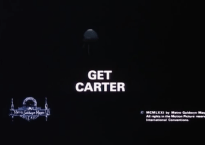
In honor of director Mike Hodges‘ gem of a crime film, that debuted 40 years ago today (and for which Ed Copeland offers an appreciation of in a blog post), a look at Get Carter‘s superb movie titles is fitting:
Some of the things I love about this film sequence:
- the first shot (after the main title) offers a wonderful literary reference as we see the character of Jack Carter (Michael Caine) reading Raymond Chandler’s Farewell My Lovely
- DP Wolfgang Suschitzky’s beautifully executed camera work, along with the slick placement of the white titles against the dark train tunnel sections, is elegant and inspired
- Roy Budd’s rhythmic jazz track, which accompanies the scene, is one of the great and neglected movie theme instrumentals around — it bookends well with Lalo Schifrin’s main title score for Bullitt, I think
- even after all these years, the surprise foreshadowing of the ‘J’ character as just another passenger on the same train car remains one of the cleverest bits by the director in the film
How About This For March Madness?
Today marks my brother’s birthday, but more importantly (hehe) it’s also the start of io9.com’s March Movie Madness: Pick the Greatest Science Fiction Movie Ever Made:
… After days of bickering, the io9ers have chosen 64 of this planet’s greatest scifi films. We poured over the details and ranked each film based on box office prowess, past io9 battles, historical significance and overall excellence. In all honesty, seeding doesn’t really matter once the tournament begins – after all, it doesn’t matter where the movies start, it only matters where they finish. Vote for which film you think deserves to be #1.
Voting at the site starts at 11 AM (through to 11PM) PST. The polls reopen each Monday, Wednesday, and Friday through to the Championship:
There will be 16 match-ups for you to vote on. Here’s the official schedule.
Wednesday, March 16 and Friday, March 18: First Round
Monday, March 21 and Wednesday, March 23: Second Round
Friday, March 25: Sweet Sixteen
Monday, March 28: Elite Eight
Wednesday, March 30: Final Four
Friday, April 1: Final Four
Monday, April 4: Championship
If you’re interested in participating, print out the PDF file of the bracket and get your selections ready. Some of the seedings are pretty damn easy (Inception vs. Independence Day… ha!), while others are going to be just plain painful (Star Trek II: The Wrath of Khan vs. THE THING… Criminy!). Let the tourney begin!
Related Articles
- It’s March Movie Madness! (fnkybee.wordpress.com)
- March Madness 2011: Will Louisville Make a Deep Run out of the Southwest Region? (bleacherreport.com)
- March Movie Madness Selection Day! (educlaytion.com)